

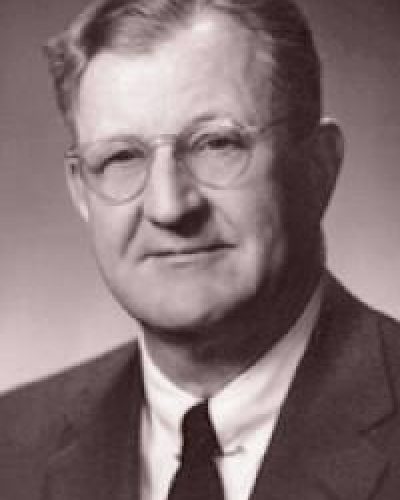
Fred Koch
The John Birch Society
Born in 1900 the son of a Dutch immigrant from Quanah, Texas, Fred Koch graduated from MIT in 1922 with a chemical engineering degree. He was first employed by the Texas Company in Port Arthur, Texas, and then by the Medway Oil and Storage Company in Kent, England, where he was chief engineer.
Only three years after graduation from college, Koch rejoined an MIT classmate at Keith-Winkler Engineering, a petrochemical engineering concern in Wichita, Kansas. His friend P. C. Keith soon moved on, however, and later in 1925, the firm was renamed the Winkler-Koch Engineering Company.
Within two years, Koch had devised a more efficient procedure for cracking crude oil – the process by which crude oil is refined into gasoline and other products. By the 1920s, the petroleum industry was fully-fledged, in no small measure in response to the needs of the burgeoning automobile industry. Then as now, the petroleum industry was dominated by a few mega-corporations that did not scruple to enlist the power of the state to enforce their near-monopolistic dominance of the industry at the expense of smaller would-be competitors.
Koch’s new royalty-free thermal cracking process, by producing higher yields of refined gasoline from crude oil and reducing downtime, helped smaller companies to better compete with their larger, more entrenched, and better-capitalized rivals. The latter lost no time in attacking Koch, filing no less than 44 lawsuits against Winkler-Koch and all its customers in a contemptible campaign to force the company out of business. That Winkler-Koch won every lawsuit but one (and that verdict was later overturned when it was discovered that the judge had been bribed) is evidence enough that the full-frontal legal assault on the upstart Koch was inspired by no higher motives than envy and greed. We must suppose that, as a result of the campaign to sue him out of the refining business, Fred Koch must have begun to understand that the modern American business sector was not nearly as free-market as it was cracked up to be.
Vindicated though he must have felt at staving off the lawsuits, they proved to be Pyrrhic victories. The cost and production delays occasioned by litigation left Winkler-Koch unable to conduct business in the United States for several years – as the Big Oil oligarchs intended. Undismayed, Koch and his associates turned their attention to potential foreign markets, including the Soviet Union, where there was a demand for American expertise in petroleum engineering. Ironically, the litigation unleashed by anti-free-market monopolists at home prompted Koch to look eastward, to the rising communist sphere of influence, for new contracts. From 1929 to 1932, Koch built 15 cracking units in the Soviet Union, and many others elsewhere in Europe, the Middle East, and Asia. He also brought Soviet technicians to the United States for training – some of whom opted not to return to their Stalinist motherland.
It was Fred Koch’s hands-on experience with Soviet Communism that convinced him of the unmitigated evil of such a system, and ultimately turned him into a passionate crusader on behalf of liberty.
Fred Koch was no fly-by-night pamphleteer. He spent a generous portion of his later years using his wealth and influence to fight the communism he abhorred. He was an early member of the The John Birch Society’s National Council, an advisory group to JBS founder Robert Welch. Koch supported a variety of freedom-related causes, all the while continuing to build the company today known as Koch Industries. Today Koch Industries produces not only a wide range of petroleum-based products and related goods like process equipment, but also has diversified into chemicals, fibers, plastics and forest and consumer products.


